Decking · Cold, hard freeze–thaw
How a composite deck ages in Denver, CO
In Denver, sun is the main stress on a composite deck: UV ranks #14 of 25 cities we cover and there are about 42 days above 90 °F. Capped boards lighten noticeably in the first two years, then stabilize; dark colors also get hot underfoot. Model estimate: 23–30 years of service.
Storyboard
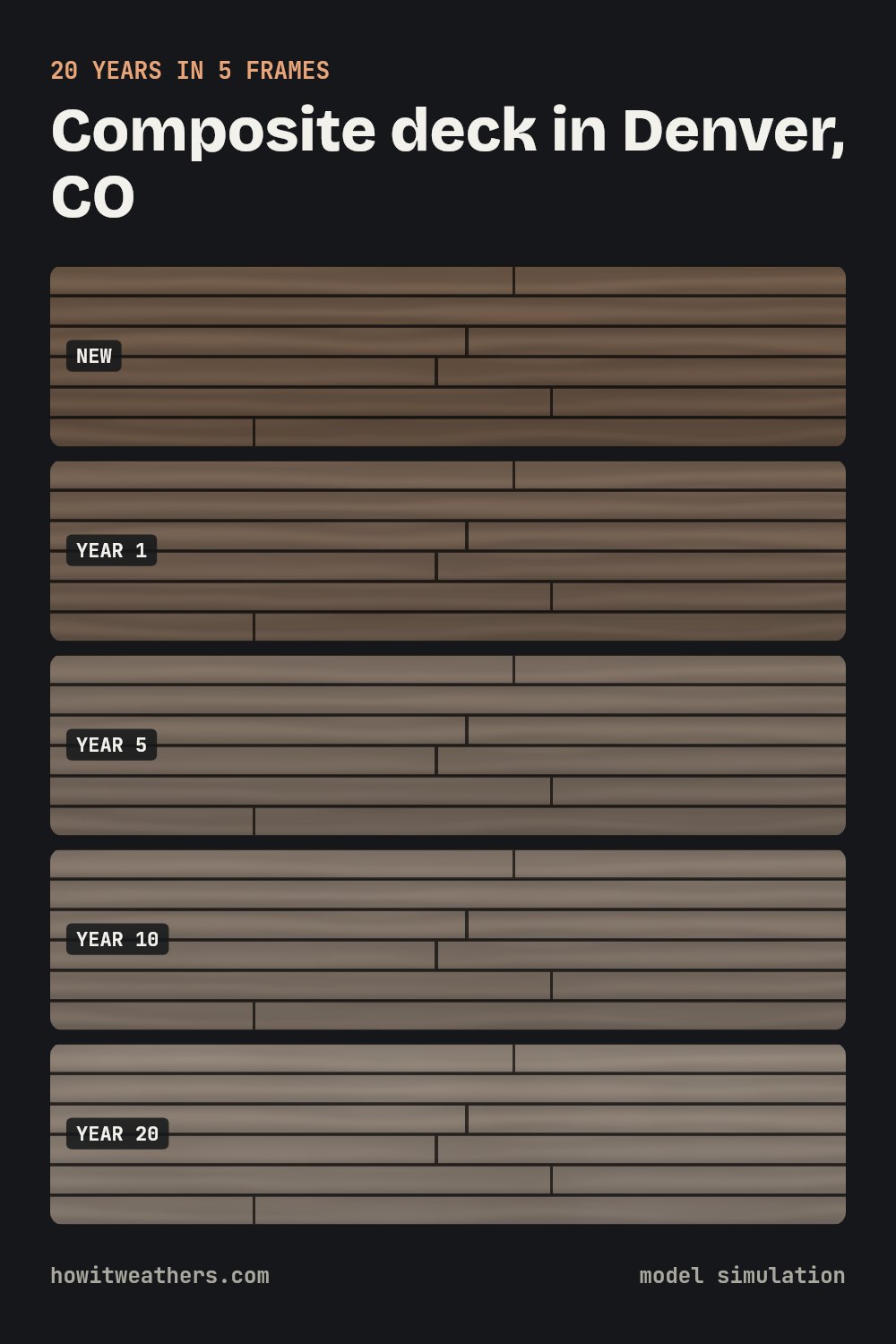
20 years in Denver, washed yearly

Denver’s wear fingerprint
Each bar is scaled to the highest of the 25 cities we cover; the black line marks the median.
NOAA station DENVER-STAPLETON (USW00023062, 10.6 km away), 1991–2020 normals · humidity & UV: NASA POWER.
What fails first here
- 1Gaps & fastenersBoards expand and contract with temperature — about 135 freeze–thaw days a year here; check hidden clips and end gaps every few years.
- 2Early color fadeCapped boards lighten in the first 1–2 years, then level off. Stronger here than average: UV rank #14 of 25.
- 3Heat underfootAbout 42 days a year top 90 °F; dark composite can get uncomfortably hot in full sun. Lighter colors help.
- 4Surface mildewComposite does not rot, but pollen and dirt on shaded boards feed mildew. A wash in spring and fall prevents it.
Upkeep
Denver maintenance calendar
Built from local normals: bar width is the share of days with rain; composite mainly needs washing.
Same city, other materials
How the alternatives age in Denver
Pin-ready
Save it for when you build.
The 20-year storyboard as a tall pin, linking back to this page.
Composite decks in similar climates
 Salt Lake City, UT
 Albuquerque, NM
 Minneapolis, MN
 Nashville, TN
 Atlanta, GA
…and in very different ones
 Miami, FL
 New Orleans, LA
 Tampa, FL
Questions Denver owners ask
How long does a composite deck last in Denver?
Our model puts a capped composite deck at 23–30 years in Denver, close to typical warranty terms. The boards outlast the look: expect some early fading and surface mildew in shade.
How often should you clean a composite deck in Denver?
Twice a year — in spring and fall. Dirt and pollen are the main thing to wash off.
Is composite worth it over cedar in Denver?
In Denver our model gives untreated cedar 14–19 years and composite 23–30. The gap is smaller where rot is slow, so upkeep preference decides.
Why does wood turn white or pale in Denver?
UV breaks down lignin at the surface; rain and wind wash the loose fibers away, leaving a bleached, silvery layer. It is cosmetic until checks open up.
Model simulation, not a guarantee: south-facing, full sun, no shade or ground-contact surprises. How it works.